Coin Market LogoCoin Gecko Logo
Breadcrumb background
Learn

What is Symverse?

What is SymVerse?
SymVerse is a Layer 1 blockchain platform that delivers approximately 1.5-second block finality through its proprietary consensus engine. The mainnet is implemented at the native architecture level to operate with dual keys (PQC/ECDSA), and it restores complete data sovereignty to users through a Self-Sovereign Identity (SSI) integrated with a membership protocol. Furthermore, it realizes a fractal network ecosystem where individual mainnets can scale infinitely, remaining independent yet organically interconnected.
what-is-symverse-background
Application of Post Quantum Cryptography (PQC) Algorithms
SymVerse adopts the most suitable methods for the blockchain environment among the standard algorithms selected by the U.S. National Institute of Standards and Technology (NIST).
  • Introduction of ML-DSA
    As one of NIST's digital signature standards, it boasts excellent signature verification speeds, making it the primary algorithm utilized in the SymVerse blockchain where high-speed processing is essential. Notably, SymVerse is the world's first to support not only ML-DSA-44 (NIST Level 2), which is used in existing quantum-resistant blockchains, but also ML-DSA-65 (NIST Level 3) and ML-DSA-87 (NIST Level 5).
  • Algorithm Comparison and Selection
    • ML-KEM
      A cryptographic key exchange algorithm for communications.
    • SLH-DSA
      A hash-based signature scheme that offers high security but has relatively slow verification speeds; thus, it was determined to be unsuitable for operating a high-speed blockchain like SymVerse.
User-Centric Membership Protocol
To ensure convenient usability and facilitate the expansion of social networks, SymVerse provides advanced membership features based on nicknames linked to each address.
  • Nickname System
    By introducing a unique nickname owned by each address, users can conveniently access services without the need for complex addresses.
  • Social Network Support
    It introduces the concepts of Referral Codes and Links to strengthen connectivity among users and support community expansion.
Structural Innovation via CAD (Consensus Authorization Digest)
SymVerse has completely resolved the data explosion problem—an inevitable consequence of introducing quantum-resistant cryptography—through its proprietary CAD technology.
  • Resolving Structural Bloat
    Through the research paper-backed CAD technology, we fundamentally solve the issue of the blockchain becoming heavy due to the introduction of PQC signatures.
  • Data Lightweighting and Efficiency Maximization
    • Separates heavy PQC signature data during the consensus process.
    • Fixed-Size (32-Byte) Recording
      By recording only a lightweight, fixed-size 32-byte CAD instead of the original signature, the proof size is kept constant, thereby maximizing overall network efficiency.
Generational Shift in Consensus Architecture Based on VRF and Stake
In response to quantum threats, we have completely redesigned the predictive algorithm for selecting block producers (Validators) and consensus security at the native level.
  • Deprecation of the Legacy Method
    The previous consensus mechanism, which selected block producers using the hash of the previous block, could be vulnerable in a quantum computing environment and is therefore fully deprecated with the introduction of PQC.
  • Introduction of VRF (Verifiable Random Function)
    New block producers are randomly selected using a Verifiable Random Function (VRF), ensuring that attackers cannot predict the next block production node.
  • Integration of the Stake Concept
    By fusing the Stake concept with the randomized selection method, the architecture is designed so that the probability of being selected as a block producer is weighted according to the deposit amount staked in the Warrant.
SymID
The SymID information makes it easy to check which blockchain mainnet is being used, and what its purpose is based on account identifiers. By reviewing the contents of the documents possessed by SymID, it is also possible to determine the legitimacy, authenticity, and status of the ID. SymID is one of the most advanced forms of the DID (Decentralized Identifier) standard recently spotlighted in the blockchain industry. A document containing different types of information along with the SymID is stored in Citizen Chain. It is generally accepted that the public key hash used as an ID in the block chain has a length of 20 bytes. Having 10 bytes of data, SymID consists of two network identifiers, six citizen identifiers, and two account identifiers. With a SymID of 10 bytes, 281 trillion IDs can be generated, and one SymID can contain 2^16 accounts (credentials).
SSI(Self Sovereign Identity)
SymID's Basic Credential simplifies complex ID information by storing ID properties, facilitating Dapp development.
FieldLengthMeaningPurpose
Key Version2bitIdentifies encryption key system versionDistinguishes ECDSA and PQC accounts
Blockchain
Network Number
14bitIdentifies network or virtual mainnetDistinguishes fractal networks and multi-mainnets
Public Key Hash8 byteIdentifier value linked to public keyGuarantees account integrity and self-sovereign identification
Multichain
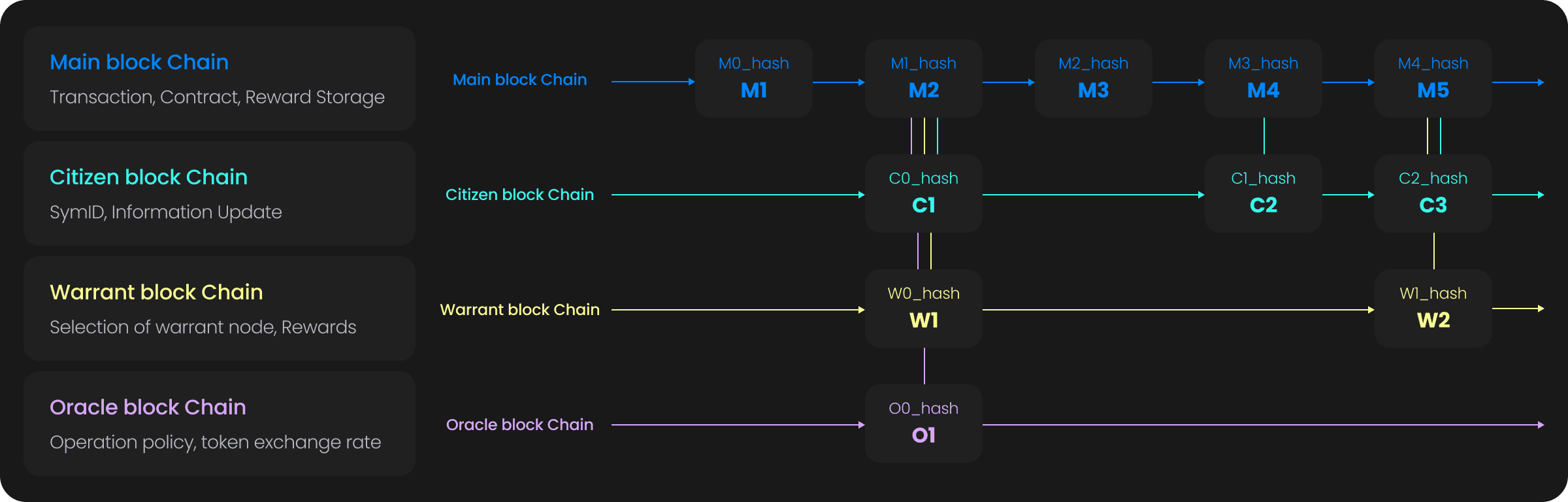
SymVerse is composed of four different blockchains, and since each block generation time is different, it can realize high data processing speed. A single blockchain node consists of the Main Chain, Citizen Chain that records ID information, Warrant Chain that records rewards, and Oracle Chain that records blockchain parameters and external information. The Main Chain has an average creation time of 1.39 seconds and is created using the enhanced BFT (Byzantine Fault Tolerant) method. Blocks in Citizen Chain that contain DID documents are created when IDs are recorded. And a Warrant Chain block that records rewards for nodes and users participating in SymVerse is created once a day. Blocks in Oracle Chain are created when recording governance voting history or data coming from external systems.
multichain
Consensus Process
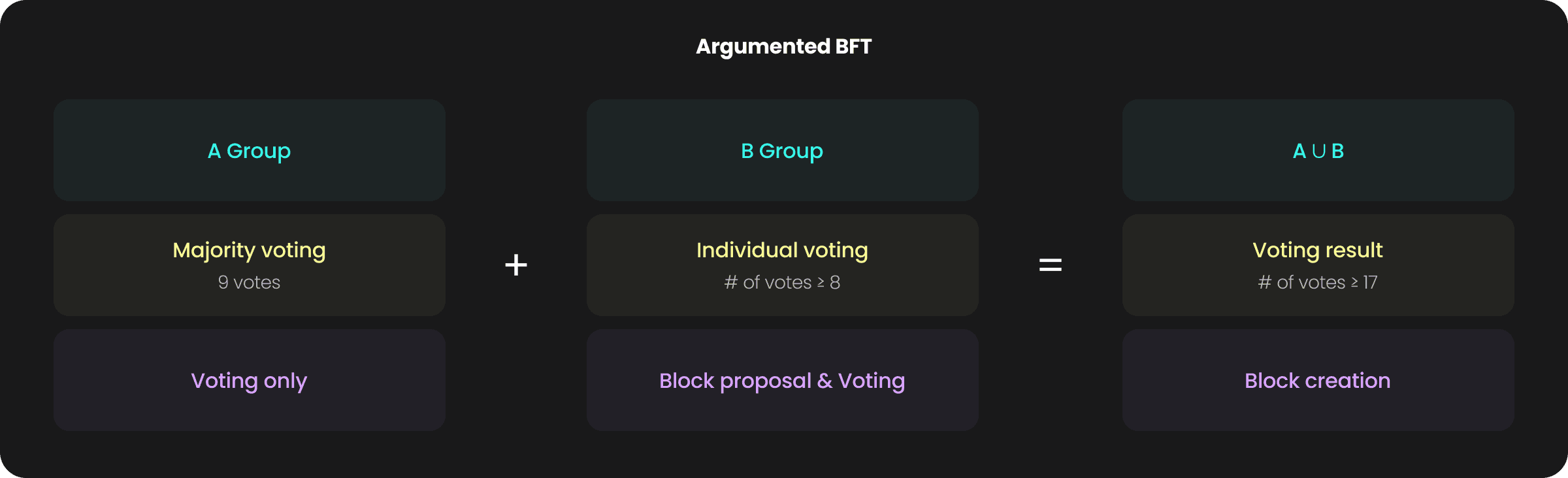
The block generation method, which agrees on the details of the data stored in the Symverse block, uses the enhanced BFT (Byzantine Fault Tolerant) method with strategic voting applied. The design of the Symverse Consensus Process is based on game theory. Utilizing the Gibbard-Satterthwaite theorem of social choice theory, made it impossible for block producers to obtain benefits by manipulating the contents of blocks through voting with Veto rights applied. There are 25 guarantee nodes, 9 of which are called group A and selected by the foundation. Group A nodes do not have the right to generate blocks, they can exert only the right to vote and collectively veto showing the same voting result. If more than 2/3 of all guaranteed nodes agree, the consensus process will be terminated. The guarantee nodes of Group B consist of 16 consensus nodes selected from candidate nodes holding deposits, and the Primary node is selected for each block generation via VRF among these 16 consensus nodes. The Primary node records the signatures of the nodes that participated in the verification, and the generated block achieves finality. The Primary node propagates the generated block to all nodes; simultaneously, the details of consensus participation are recorded in the Warrant Block, and the coins generated with every block are distributed to the consensus nodes every 2,400 blocks.
multichain
Block Confirmation
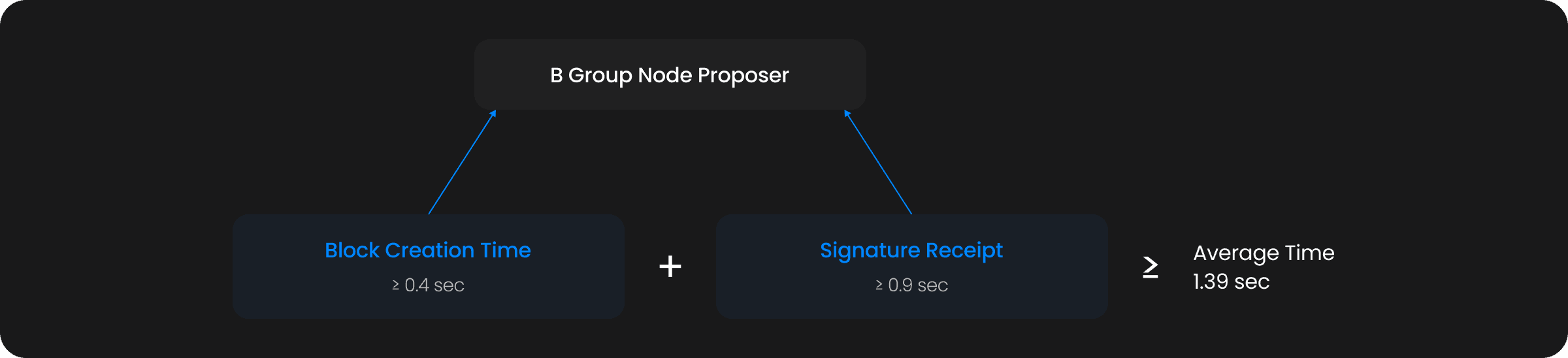
The main chain is created within 1.39 seconds on average, including the block generation time and the time the proposer receives the signature from the nodes participating in the consensus process. Therefore, the details of the main chain can be used after the block contents are confirmed through creation and signature. (Unlike EOS, Cosmos, and Ethereum, the transaction is confirmed at the time of creation)
multichain